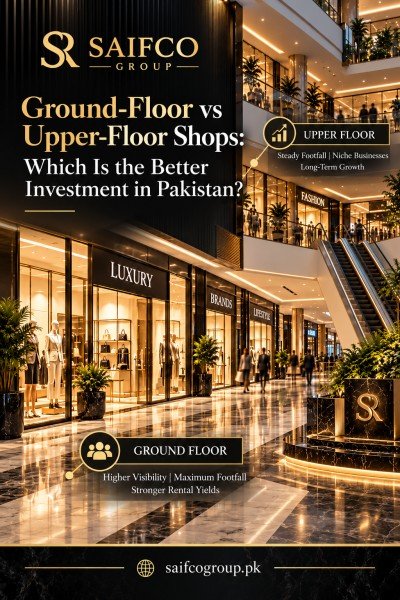
Buying a commercial shop in Pakistan often begins with one important question: should you invest in a ground-floor shop or an upper-floor unit? Ground-floor shops typically offer greater visibility and convenient access, but their purchase prices are often higher.
An upper-floor shop may cost considerably less and attract tenants whose customers visit by appointment or for a specific purpose. The better investment depends on purchase price, sustainable rental income, customer access, vacancy risk and resale demand.
This blog compares both options and highlights commercial opportunities across Saifco Group’s real estate developments.
Ground-Floor vs Upper-Floor Shops: Key Differences
Investment factor | Ground floor | Upper floor |
Purchase price | Often higher | Often lower |
Visibility | Usually direct frontage | Depends on layout and signage |
Customer traffic | Stronger impulse potential | More destination-driven |
Tenants | Convenience retail, fashion, food | Clinics, salons, offices, entertainment |
Main risk | Overpaying for frontage | Weak access or leasing demand |
Rental yield | Depends on price and costs | May outperform at lower price |
A ground-floor shop can generate higher rent without necessarily producing the higher percentage return. Investors should compare the total capital required with dependable net income.
Why Are Ground-Floor Shops More Expensive?
Visibility and Walk-In Customers
A shop near a mall entrance, busy walkway or main road benefits from greater exposure. This matters most for businesses that rely on quick or spontaneous purchases, including pharmacies, accessories shops, bakeries and convenience retailers.
Access and Retail Frontage
Customers can usually enter a ground-floor unit without finding a lift or escalator. Prominent windows and signage also help retailers display products and attract passing visitors.
The Risk of Paying a Premium
Ground-floor pricing can carry a substantial location premium. Paying more is sensible only if realistic rental demand, lease terms and future resale value justify that extra cost. High rent alone does not prove a strong investment return.
Are Upper-Floor Shops a Good Investment in Pakistan?
An upper-floor shop investment can work well when the unit has a comparatively low purchase price and suits tenants who attract intentional visits rather than impulse traffic.
- Medical and dental clinics:patients typically arrive for planned appointments.
- Salons and wellness studios:customers may book in advance and accept upper-floor access.
- Offices and professional services: privacy and layout can matter more than walk-in visibility.
- Dining or entertainment:strong destinations can draw visitors to upper levels.
However, upper-floor units face risks when escalators are unreliable, corridors are confusing, signage is weak or the approved use does not match tenant requirements. A lower price cannot compensate for an unlettable unit.
Which Businesses Perform Better on Each Floor?
Business | Location to investigate | Main reason |
Convenience store or pharmacy | Ground floor | Quick customer access |
Fashion and accessories | High-footfall retail level | Displays and browsing |
Salon or clinic | Accessible upper floor | Appointment-led demand |
Corporate office | Upper floor | Workspace and privacy |
Restaurant or cinema | Location-dependent | Destination traffic and facilities |
These are practical tendencies, not guarantees. A well-positioned upper-floor restaurant may outperform a hidden ground-floor unit. Evaluate each tenant’s business model, approved use and customer journey.
How Access, Escalators and Parking Affect Shop Performance
Floor level should never be assessed separately from the development’s design. A shop close to an escalator landing or main atrium may gain more exposure than another unit on the same floor.
- Lifts and escalators:check reliability, capacity and opening hours.
- Anchor tenants:identify supermarkets, food courts and entertainment that attract visitors.
- Parking access:inspect the actual customer route from parking to the shop.
- Frontage and signage:confirm visibility from primary corridors and approaches.
- Footfall:measure traffic passing the particular unit, not the mall entrance alone.
For a structured inspection process, read Saifco Group’s guide on measuring footfall before buying a commercial shop.
Ground-Floor vs Upper-Floor Shops: Comparing Rental Yield
The simplest gross rental yield calculation is annual rent divided by purchase price, multiplied by 100. A more useful comparison deducts vacancies and non-recoverable owner expenses before comparing income with invested capital.
Net rental yield = (annual rent collected − annual owner expenses) ÷ purchase price × 100. For a real transaction, add acquisition taxes, transfer charges and relevant costs to the investment base.
Worked Investment Example: When Can an Upper Floor Win?
The following figures are illustrative, not current Saifco asking prices or verified market rents. Acquisition charges are excluded from both investment bases to isolate the floor comparison.
Metric | Ground-floor unit | Upper-floor unit |
Purchase price | PKR 20,000,000 | PKR 12,000,000 |
Monthly rent | PKR 140,000 | PKR 95,000 |
Months rented each year | 11 | 10 |
Collected annual rent | PKR 1,540,000 | PKR 950,000 |
Annual owner costs | PKR 200,000 | PKR 120,000 |
Net annual income | PKR 1,340,000 | PKR 830,000 |
Net rental yield | 6.70% | 6.92% |
The ground-floor unit produces PKR 510,000 more net rental income each year. Yet the upper-floor shop produces a slightly higher percentage yield because the initial purchase price is much lower.
At ten rented months and PKR 120,000 annual owner costs, the upper-floor unit requires approximately PKR 92,400 per rented month to match the ground-floor yield of 6.70%. At PKR 95,000, it exceeds that benchmark modestly.
A few additional vacant months or weaker rents would reverse the result. Investors should therefore test conservative rental assumptions, maintenance increases and the likelihood of finding another tenant.
What Is the Best Floor for Commercial Shop Investment?
Prioritise the ground floor when the tenant needs convenient entry, product displays or impulse footfall and the rent justifies the location premium. Consider upper floors when the unit has good vertical access, credible appointment-based tenant demand and a price that supports an attractive risk-adjusted yield.
Saifco also explains wider mall investment risks in Is Buying a Shop in a Mall a Good Investment in Pakistan?.
Why Invest in Saifco Group’s Commercial Projects?
Choosing the right developer, location and commercial environment is as important as selecting the floor. Saifco Group, established in 1971, has developed commercial malls and mixed-use buildings in Islamabad and Rawalpindi. The following projects provide different business environments worth comparing.
Galleria Mall I-8 Islamabad: Established Commercial Location
Located in I-8 Markaz, Galleria Mall provides approximately 67,200 sq ft of covered space, with retail and dining areas, circulation facilities and a central commercial catchment. Its position is worth examining for visibility-focused retailers and service businesses.
Explore Galleria Mall I-8 Islamabad and review a particular unit’s frontage, access and leasing demand.
Silk Mall Islamabad: Different Floors, Different Uses
Silk Mall on Main G.T. Road near Bahria Town combines retail areas with spaces planned for food, entertainment and offices. Its approximately 106,000 sq ft of covered space illustrates how destination uses may support different floor levels.
See the Silk Mall Islamabad project for development features and project information.
Emporium Mall F-10: Retail and Lifestyle Attractions
Emporium Mall in F-10 Markaz, opposite Fatima Jinnah Park, includes retail space, dining and entertainment attractions. Its central atrium and varied uses make customer circulation and proximity to destination tenants important considerations.
Explore Emporium Mall F-10 Islamabad and evaluate the location of any available unit relative to visitor routes.
Silk Centre Rawalpindi: Retail and Office Environment
On Main Murree Road between Chandni Chowk and Sixth Road, Silk Centre includes retail shops and corporate office space across a seven-floor development. It presents a useful example of how commercial floors can serve different tenant requirements.
View Silk Centre Rawalpindi for details.
Commercial Shop Site-Visit Checklist
- Confirm approved use, ownership documents and exact covered area.
- Inspect weekday and weekend visitor flows near the specific unit.
- Check all lift, escalator, parking and signage connections.
- Compare asking rent with evidence from comparable occupied units.
- Request written maintenance, transfer and other ownership charges.
- Stress-test the return for vacancy, lower rent and future repairs.
Frequently Asked Questions
No. Ground-floor units may have higher visibility, but an excessive purchase premium can reduce percentage returns. Compare sustainable rent, total costs and vacancy risk.
They can be when the building has dependable access and demand from businesses such as clinics, salons, offices or destination retailers. Each location requires independent verification.
No floor consistently offers the highest yield. Calculate actual net rental income relative to acquisition cost and assess whether the rental assumptions are credible.
Convenient escalators and lifts can make upper floors more accessible, but performance depends on placement, operating reliability, tenant demand and actual customer movement.
Final Thoughts
There is no universal winner in the ground-floor vs upper-floor shop comparison. Ground-floor retail may suit businesses relying on visible, convenient access. Upper-floor units may provide better relative value when acquisition prices are lower and demand from destination tenants is proven.
Choose the unit that combines dependable tenant demand, realistic net rental income, good accessibility and acceptable risk. Do not rely only on floor number or marketing projections.